AI platform for a maritime expert in control and automation technology

Facts & figures
The challenge: bringing standards knowledge and engineering know-how together in complex analyses
In the maritime industry, system analyses for safety-critical systems are a regulatory requirement and technically extremely demanding. A complete Failure Mode, Effects and Criticality Analysis (FMECA) according to IEC 60812 requires a deep technical understanding of your own systems and a confident command of the normative requirements. The underlying standards and classification guidelines alone run to more than 500 pages.
The challenge is not a lack of will but a lack of access: standards, internal system documentation, electrical diagrams, component specifications and experience from past projects are spread across many documents and systems. Anyone carrying out a complete system analysis spends much of their time not on the actual engineering judgement but on searching, cross-referencing and gathering the basics.
Every project is unique and often consists of more than 5,000 parts and over 500 components. The technical and commercial analysis is correspondingly complex, and it requires expertise throughout the entire process: from the quote in sales, through supporting product management, to project engineering and service.
The solution: MAIA as the central access point to knowledge for system analyses
Hoppe Marine uses MAIA as a knowledge platform that supports engineering in producing system analyses that comply with the standards. The approach combines standards knowledge, internal engineering know-how and project-specific data in a single, fully accessible knowledge system whose answers can be validated:
- Regulatory foundations are stored in MAIA and available straight away, with no more manual searching through 500-page standards.
- Templates from Hoppe’s own FMECA tables and standards committees serve as a structural model that MAIA takes into account directly.
- Engineering knowledge such as technical system documentation, electrical diagrams and component specifications is added per project and can be searched immediately.
- Persona prompting puts MAIA in the role of an expert assistant with a clear glossary and normative context, so the answers stay consistently at the right technical level.
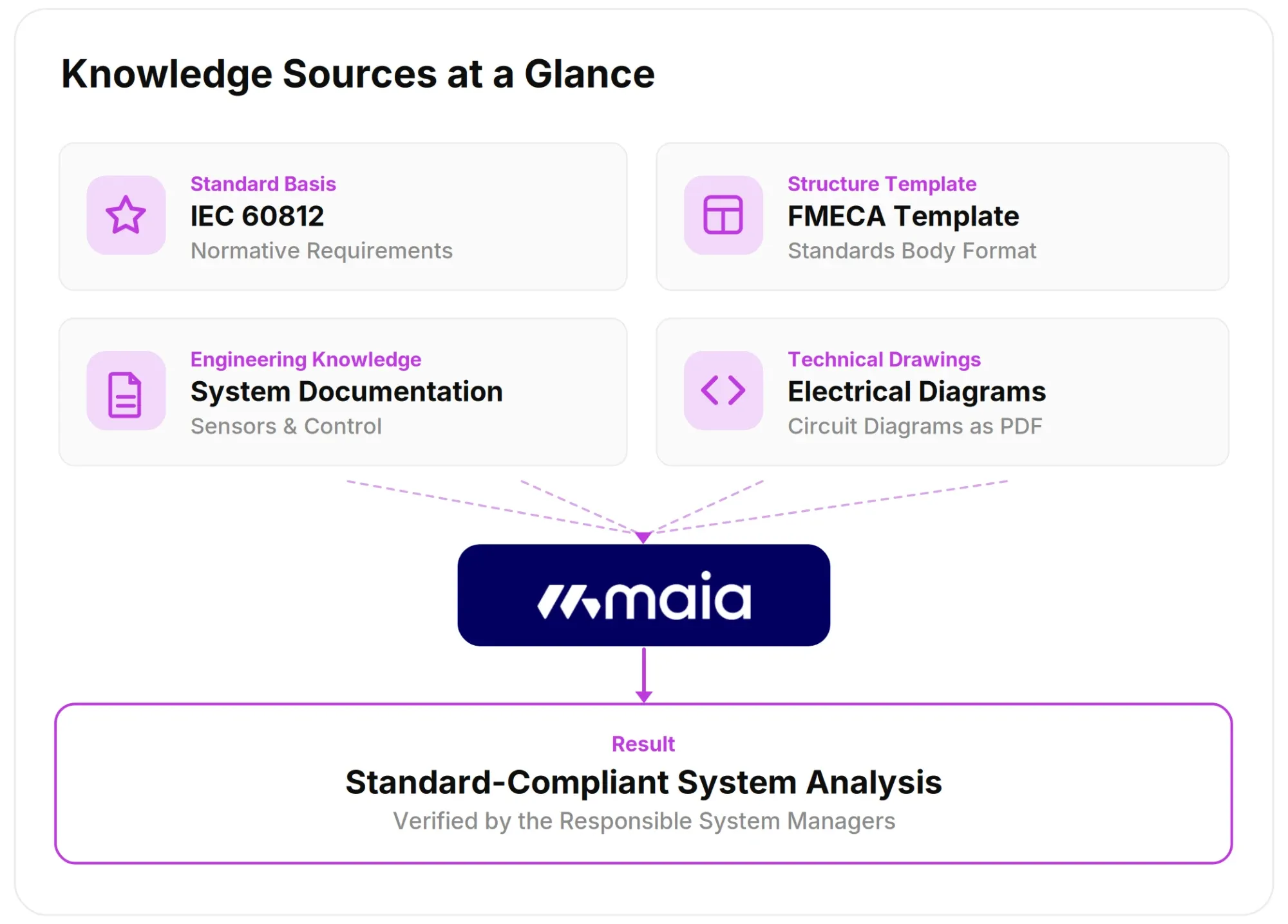
This lets engineering focus on engineering judgement rather than on gathering the basics. Verifying and validating all analysis results naturally remains with the responsible system managers.
The result: more time for engineering judgement, with the same normative quality
With MAIA, most of the working time shifts from gathering information to the actual value creation: the expert judgement, verification and derivation of technical measures by the specialists at Hoppe Marine. Decisions are still made by people. MAIA takes over the research, not the judgement. That suits a working day in which being available and responding quickly to customers remain important. And it shows where the real benefit lies: in the interplay between MAIA and the team’s experience.
Faster, more reliable quotation decisions
During a quotation phase, MAIA provides all the relevant standards and experience within a short time. Sales and project management can assess technical risks soundly, even for system concepts being built for the first time, and quantify the commercial consequences reliably.
Knowledge transfer within the company
The projects, templates and technical documents stored in MAIA are used beyond the knowledge management team, for example to structure internal e-learning courses across three knowledge levels (Basic / Advanced / Expert).
Primary use cases
Support with system analyses (FMECA) for ongoing projects
MAIA provides engineering with structured access to:
- Normative requirements
- Experience from past projects
- Internal system documentation on sensors, pumps and control components
- Wiring and circuit diagrams as searchable PDF sources
- Project-specific templates for the output format
Simplified system analysis for the quotation phase
MAIA helps to assess new project concepts quickly through access to:
- Customer specifications from the request for quotation
- Experience from comparable system standards
- Technology options including availability and supplier data
- Minimum normative requirements for assessing the quote
Example prompts
If you have any questions, you can contact Lars Jaspersen of Hoppe Marine at l.jaspersen@hoppe-marine.com.
In summary
- At Hoppe Marine, MAIA has processed more than 12 million words of industrial knowledge.
- With MAIA, Hoppe Marine assesses more than 70 subsystems and components per FMECA analysis according to IEC 60812.
- At Hoppe Marine, MAIA opens up more than 500 pages of standards without any manual searching.
“MAIA has become a central tool for our team! We now use MAIA very intensively and, with the tool’s support, have been able to produce excellent documentation and gain valuable experience. For us, it’s clear that we want to keep using MAIA in the future.”




















Let’s get started.
In a first intro call, we’ll work out together what a good start with MAIA looks like for you.
Book an intro call