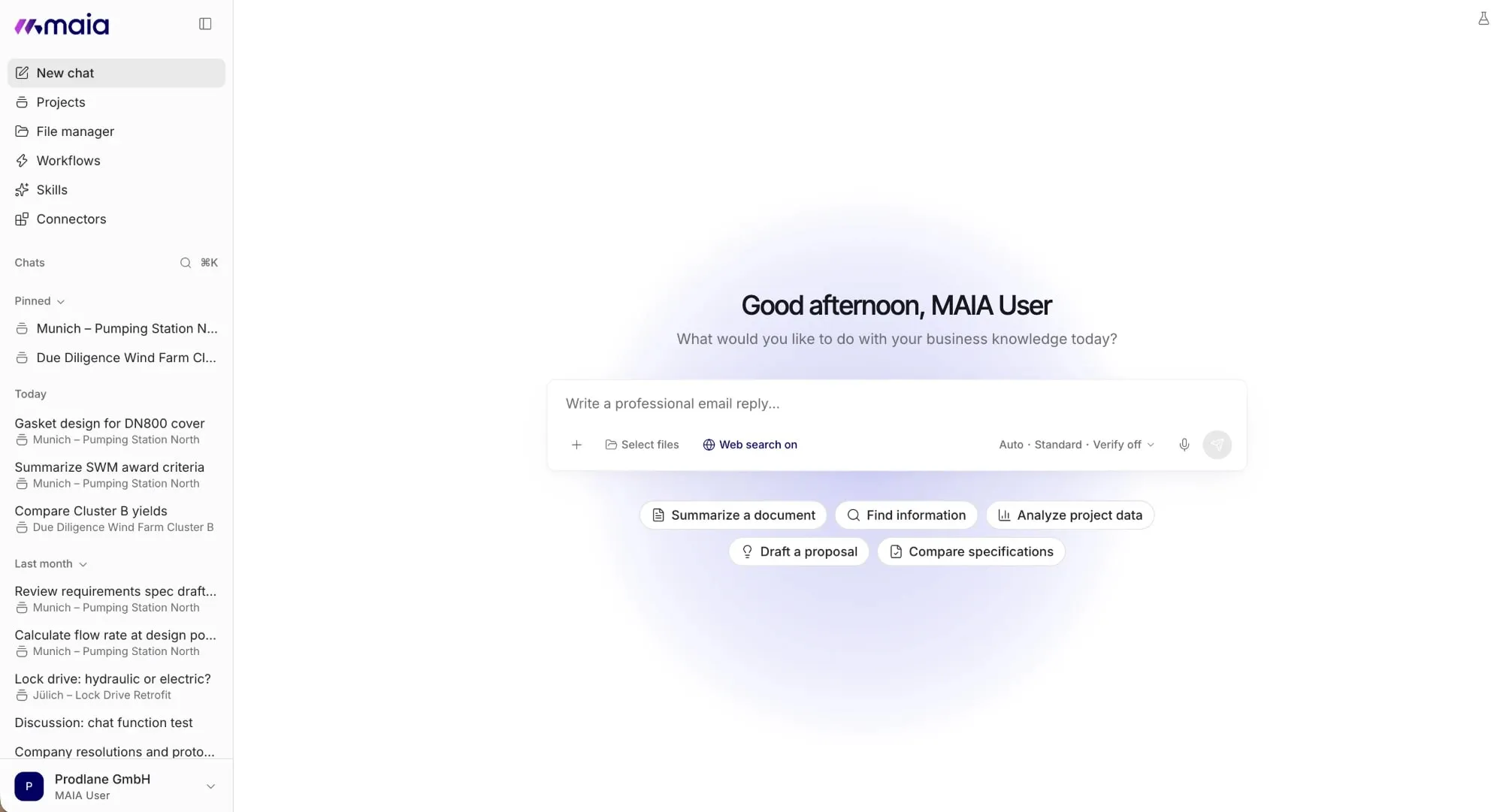
A new model every day, new AI headlines every day. Many companies hardly know what to bet on when it comes to AI any more. MAIA offers two things in response: companies have models from several providers in one place, all operated in the EU, and they do not have to commit to any of them. And a dedicated team in Leipzig shows them how AI works in their day-to-day work. With version 2.0, the platform has also been completely redesigned.
Leipzig, November 13, 2026. The AI market is loud. A new model comes out almost every week, every provider promises the next big leap, and many companies wonder whether they are backing the wrong horse. Carolin Maier thinks this rush is the wrong approach. The Swiss co-founder of Leipzig-based Prodlane GmbH brings an attitude that is second nature in her home country of Switzerland: do not tie yourself to one side, weigh things up calmly and keep the decision in your own hands.
MAIA has long refused to commit to a single provider. It works with models from Anthropic and OpenAI as well as with open models. All models are operated exclusively in the EU. Teams choose for themselves which model they work with. Anyone who does not want to choose lets MAIA decide, depending on the request.
"In Switzerland, people don't chase every trend. They take a close look and then decide. That calm is completely missing from the AI market right now. Companies shouldn't have to ask themselves every week whether they have the right model. That is our job, not theirs. Calm comes from someone who knows the way and stays," says Carolin Maier, CEO and co-founder of MAIA.
Seven weeks, one team of developers
Mathias Jakob, CTO and co-founder, is responsible for how this works technically. For the new version, MAIA 2.0, his team of developers really stepped on the gas: in seven weeks, they rebuilt the platform and completely redesigned the interface. Behind this lies a conviction: Europe, and Germany in particular, needs its own AI platforms that decide for themselves which models they use, instead of following the pace set by individual US corporations.
The foundation for this did not arrive with 2.0: MAIA has always been model-agnostic. No model is hard-wired, and teams have the choice. New models are added as soon as they become available, without customers having to change anything.
MAIA 2.0 builds on this, with a completely new interface, new features and connections to 20 more business systems such as Microsoft, Google, HubSpot, Personio and many more.
Why European, and especially German, AI matters
Many companies in Germany, Austria and Switzerland hesitate about AI for one reason: their most valuable knowledge sits in confidential documents. Design documents, test reports, contracts, client files. Anyone who entrusts these records to an AI wants to know where the data is stored, which law applies and whom to call if something is wrong.
MAIA is developed in Leipzig. Onboarding, training and support are handled by a team that knows its customers personally. In June 2026, Technologiegründerfonds Sachsen (TGFS) and Sächsische Beteiligungsgesellschaft (SBG) invested four million euros in the company. Several dozen companies from the DACH region already work with MAIA, including Netzsch and Ovesco Endoscopy.
Data security: control stays with the company
All models in MAIA are operated exclusively in the EU, including those from Anthropic and OpenAI. Companies also decide for themselves which models work with their documents. Processing complies with the GDPR and is governed by a data processing agreement. External penetration tests check the platform, and ISO 27001 certification is in preparation.
"Confidential documents don't belong in a black box. Our customers decide for themselves which models work with their data. Where the data is processed, on the other hand, is fixed: always in the EU," says Carolin Maier.
Without support, even the best AI is useless
The right model alone does not bring calm. Most AI rollouts fail because nobody is around any more once the licences have been bought. That is why onboarding and training are part of the platform at MAIA, right down to every team.
This gives orientation: together with the MAIA team, companies decide where AI helps first, and every team learns with its own tasks, not with textbook examples. And it gives reliability: dedicated contacts in Leipzig know their customers' processes and accompany every new version, including the move to MAIA 2.0.
"Something changes in the AI market every week. Our customers should be able to rely on someone at our end keeping track and telling them what matters to them. We don't sell a licence and then disappear. We stay," says Carolin Maier.
Availability
MAIA 2.0 is available to all customers from November 13, 2026.
Want to learn more about MAIA 2.0?